Meeting #1: Read the introduction to Experiment in Criticism and chapters 1-3.
Does having high standards for books make you a snob? And does reading a lot necessarily make you a good reader? C. S. Lewis gives us plenty to argue about—and plenty to recognize in ourselves.
In this episode, we discuss how good books change our tastes, why we return to books we already know, and how we can read a great book without really receiving what it has to offer.
Along the way, we debate Christian romance, rock music, audiobooks, and the demand that something must always be happening. Join us for a lively conversation about learning to enjoy good books—and getting ourselves out of the way long enough to actually read them.
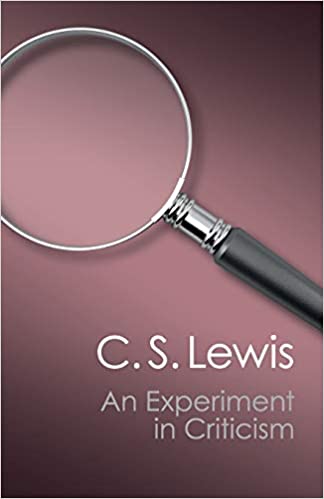
Discussing Experiment in Criticism by C.S. Lewis (Introduction, Ch. 1-3)
Why do we read literature and how do we judge it? C. S. Lewis’s classic An Experiment in Criticism springs from the conviction that literature exists for the joy of the reader and that books should be judged by the kind of reading they invite. He argues that ‘good reading’, like moral action or religious experience, involves surrender to the work in hand and a process of entering fully into the opinions of others. Amid the complex welter of current critical theories, C. S. Lewis’s wisdom is valuably down-to-earth, refreshing and stimulating in the questions it raises about the experience of reading.
CLIVE STAPLES LEWIS (1898-1963) was one of the intellectual giants of the twentieth century and arguably one of the most influential writers of his day. He was a fellow and tutor in English Literature at Oxford University until 1954 when he was unanimously elected to the Chair of Medieval and Renaissance English at Cambridge University, a position he held until his retirement. He wrote more than thirty books, allowing him to reach a vast audience, and his works continue to attract thousands of new readers every year.
His most distinguished and popular accomplishments include Mere Christianity,Out of the Silent Planet, The Great Divorce, The Screwtape Letters, and the universally acknowledged classics, the Chronicles of Narnia.
Opening Quote
Good books grow good taste
Liking a book does not make it a good book. We can have bad taste. We can also grow out of it.
Exposure breeds taste. When we read bad books over and over, we develop an appetite for them. When we stop reading them and spend time with better books, our tastes can change.
Replace twaddle with good books and, like giving up sugar, your taste will adapt.
Have standards without despising people
Some books are better than others. It’s just true.
Holding a standard does not mean despising people who have bad taste. Likely, we have had bad taste ourselves. We are not stuck with it, and neither are they.
Nor does having good taste mean we can only enjoy great works of literature. We can appreciate a lighter book for what it is. The problem comes when we cannot enjoy anything but twaddle—when we demand constant action and treat language, descriptions, and character development as clutter getting in the way of the story.
Be a good reader, reading good books
We can take a good book and read it badly. We can read classics to have read them, to prove we are smart, without paying close enough attention to benefit from them.
Good reading requires us to receive what the author actually wrote. We have to stop rushing past the words toward our own thoughts and connections.
Sometimes that means feeling the discomfort of a slower pace. We need to settle into the setting, spend time with the description, and keep picking up the book.
Better taste grows through practice. Read books recommended by people with better taste than yours. Read classic children’s literature aloud to your children. Give good books your attention.
You do not have to begin with excellent taste. But to develop good taste, you do have to read good books.
Scholé Sisters is committed to equipping homeschool moms with intellectual courage and increasing the number of thinking Christian women (homeschoolers…