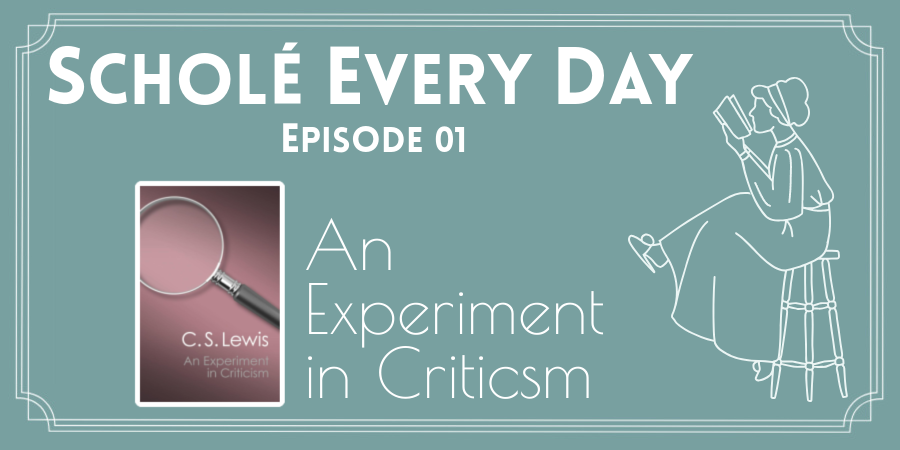
Meeting #2: Read Experiment in Criticism and chapters 4-6.
Is reading a fairy tale any more of an escape than reading the news? C. S. Lewis says all reading is a kind of escape. The question is what we’re escaping into.
In this episode of Scholé Every Day, Brandy, Abby, and Mystie tackle the middle section of An Experiment in Criticism. They talk about why children should read fairy tales, how an agenda changes what we see in a book or a painting, and what happens when we take Emma as life advice. Along the way, they ask what it takes to enter into another person’s experience, even when we disagree with their view of life.
[X] Receiving a book or piece of art on its own terms
[x] Reading as escape
[X] Story truth and factual truth
[X] The trouble with castle-building
[X] Childlikeness without childishness
[X] Self-forgetfulness and receiving another perspective
The Scholé Sisters:
Brandy Vencel insists on good books in her house
Mystie Winckler thinks audiobooks count
Abby Wahl suggests you take a walk
Discussing Experiment in Criticism by C.S. Lewis (Ch. 4-6)
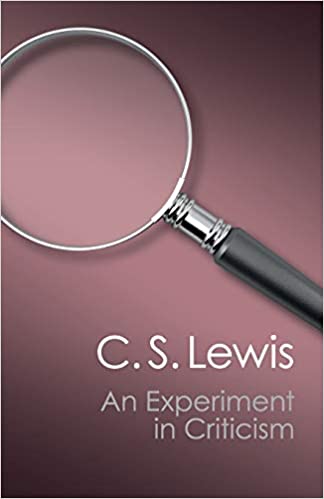
Why do we read literature and how do we judge it? C. S. Lewis’s classic An Experiment in Criticism springs from the conviction that literature exists for the joy of the reader and that books should be judged by the kind of reading they invite. He argues that ‘good reading’, like moral action or religious experience, involves surrender to the work in hand and a process of entering fully into the opinions of others. Amid the complex welter of current critical theories, C. S. Lewis’s wisdom is valuably down-to-earth, refreshing and stimulating in the questions it raises about the experience of reading.
CLIVE STAPLES LEWIS (1898-1963) was one of the intellectual giants of the twentieth century and arguably one of the most influential writers of his day. He was a fellow and tutor in English Literature at Oxford University until 1954 when he was unanimously elected to the Chair of Medieval and Renaissance English at Cambridge University, a position he held until his retirement. He wrote more than thirty books, allowing him to reach a vast audience, and his works continue to attract thousands of new readers every year.
His most distinguished and popular accomplishments include Mere Christianity,Out of the Silent Planet, The Great Divorce, The Screwtape Letters, and the universally acknowledged classics, the Chronicles of Narnia.
Children are not deceived by fairy tales. They are often and gravely deceived by school stories. Adults are not deceived by science fiction. They can be deceived by the stories in the women’s magazines. None of us are deceived by the Odyssey, the Kalevala, Beowulf, or Malory. The real danger lurks in sober-faced novels, where all appears to be very probable, but all is in fact contrived to put across some social or ethical or religious or anti-religious comment on life, for some at least of such comments must be false. To be sure, no novel will deceive the best type of reader. He never mistakes art either for life or for philosophy. He can enter while he reads into each author’s point of view without either accepting or rejecting it, suspending when necessary his disbelief and, what is harder, his belief. But others lack this power. C.S. Lewis, Experiment in Criticism, 67-68
What artist study teaches us about reading
If a child knows she’ll be asked how many trees are in a painting or what color the woman’s dress is, she’ll start counting trees and noticing the color of clothes. Karen Glass used that example to show what happens when the same kinds of questions follow every picture study. Over time, the questions change the way the child looks at the painting. Ask her to picture the whole thing in her mind, and the whole thing matters.
The same thing happens with books. Mystie remembers a literary analysis class where she knew before she read the story that she’d have to write about it from a feminist or Marxist framework. Whatever the story was, she had to fit it into the framework. When a reader always comes in with an agenda, she starts seeing it there.
That’s why narration is so valuable. The reader puts it in her own words and makes sure she understands what’s there before she worries about her thesis or her opinion. Application can wait until she’s fully received what the author is saying and how the author is saying it.
When escape is good
“All reading, whatever, is an escape,” says C. S. Lewis. A reader leaves her immediate surroundings for a while, whether she’s reading a fantasy, a history book, or a news article. The important question is what she escapes into. She might spend that time building castles in her head, or she might enter into the author’s perspective and see what it’s like to look at life that way.
When people call a book “escapist,” the sisters point out, they often mean it’s shallow or twaddly. But Lewis says escape is common to many good and bad kinds of reading. There’s something right about losing herself in a book. For a while, the reader gets to be self-forgetful.
Reading honestly & disinterestedly
A reader can give a book that same attention even when she disagrees with its view of life. When she reads a tragedy, she can spend a little less time asking whether she agrees with its philosophy and a little more time finding out what it is saying.
Lewis compares a true lover of literature to an honest examiner who can give high marks to a well-made case for a view she strongly disagrees with. She can see the art in it, even if she disapproves.
Scholé Sisters is committed to equipping homeschool moms with intellectual courage and increasing the number of thinking Christian women (homeschoolers…